I have read and evaluated your final papers. For the most part, your papers are well done. After a little bit of rest--maybe by tomorrow--I will post the letter grades for your papers on the class webpage.
Your letter grades for the course should be available to you within the next couple of days through the university's online services. Feel free to contact me after that if you think I might have erred in computing the letter grade for the course.
My thanks to many of you who added in the emails, or sometimes in the final paper, a sentence or two appreciating this course and my teaching.
I have often commented to colleagues, and blogged too, that as a teacher this is probably one of the best differences between a regular class and an online class: on their own, students convey their appreciation in the online environment, but rarely do in a regular class.
Of course, it could be because my regular classes suck! But, I think--or, I want to believe--that the online environment makes it easy to say nice things, whereas a face-to-face interaction can potentially make it an awkward interaction, for the student or the teacher or both. Many times I have even ended up as a messenger--students tell me that a professor X was awesome, and I have then conveyed that to X :-)
Enjoy the rest of the summer. I hope to see you around--either in one of my classes, or when you drop in for a chat. Yes, swing by and say hi anytime you see me in my office at HSS 219.
Monday, August 3, 2009


Friday, July 31, 2009
Final paper: a reminder

Hey, I want to make sure that you are working on your final papers.
The deadline is August 1st (Saturday).
Incidentally, if you have missed out on the news because of the paper and assignments you are working on, big time clashes broke out in Nigeria.
Nigerian security forces chased fleeing members of Boko Haram a day after the leader of the Islamist sect was killed amid fighting in which at least 600 people died.Well, you know where Nigeria is (you do, right?), the importance of the Sahel and the north-south split, .... and thanks to the article in the Atlantic that you read, you even have a fairly good idea of the religious tensions in Nigeria.“There are still isolated incidents here and there” in Maiduguri, capital of the northeastern state of Borno, said Emmanuel Ojukwu, the national police spokesman.
Fighting erupted in northeastern Nigeria on July 26, when Islamists attacked police stations in the state of Bauchi. The clashes spread to at least four other states. Boko Haram, a group that is sometimes referred to as the Nigerian Taliban and wants to impose sharia law across the entire country, was involved in the attacks, according to IHS Global Insight, a Lexington, Massachusetts-based research group.
The group’s 39-year-old leader, Mohammed Yusuf, was killed after being taken into custody yesterday, Agence France-Presse reported today, citing the League for Human Rights. Ojukwu confirmed Yusuf’s death.
Monday, July 27, 2009
Burma, SE Asia and E Asia
Hey, this is the final week of the summer term. Bear with the Valley's heat and complete your work first. You can always play later :-)
One of the difficulties in teaching any course is to keep in mind that the material will be old to the teacher but is new to the student. And, therefore, for the teacher to "see" it with the eyes of a freshie to the subject. As Therese Huston writes in this essay in the Chronicle of Higher Education,
 I find this an interesting and enjoyable challenge, particularly in GEOG 310 and 410. If at all, I find that students do not ask enough questions because, I suspect, they think their questions might make them come across as not knowing enough about the world. In my "regular" classes I always comment that if they already knew the stuff, well, I will then be out of a job--at least this is my attempt at humor to convince them to shed that baseless fear.
In this class, whether it worked out well or not, I decided not to have any discussion-questions at all. It kind of made our class a quiet class, I suppose. I will assume that the quietness had nothing to do with your reservations to ask questions, or comment.
A few quick comments on the regions we covered through Mapwork 3:
One of the difficulties in teaching any course is to keep in mind that the material will be old to the teacher but is new to the student. And, therefore, for the teacher to "see" it with the eyes of a freshie to the subject. As Therese Huston writes in this essay in the Chronicle of Higher Education,
[Being] an expert can get in the way of seeing the issues from a student's perspective. The beauty of being a content novice is that you have an outsider's level of excitement and curiosity. Questions that might be demeaning to experts are enticing to content novices, just as they'll be enticing to your students —who will be more interested in learning because you've asked the right questions from the start.
 I find this an interesting and enjoyable challenge, particularly in GEOG 310 and 410. If at all, I find that students do not ask enough questions because, I suspect, they think their questions might make them come across as not knowing enough about the world. In my "regular" classes I always comment that if they already knew the stuff, well, I will then be out of a job--at least this is my attempt at humor to convince them to shed that baseless fear.
In this class, whether it worked out well or not, I decided not to have any discussion-questions at all. It kind of made our class a quiet class, I suppose. I will assume that the quietness had nothing to do with your reservations to ask questions, or comment.
A few quick comments on the regions we covered through Mapwork 3:
- I don't care what the world says; almost always I refer to the country as Burma and not as Myanmar. It is my own way of protesting against the junta that has literally and figuratively choked the lives of many, many Burmese. Let a democratically government change the name, and I too shall refer to the country as Myanmar :-)
- Burma, like many of the countries in SE Asia and South Asia experiences monsoon rains. The monsoon rains are a lot different from the rains in the Willamette Valley. They come down in a hurry sometimes, dumping inches in a matter of hours.
- East Asia has its own "typhoons" that can cause quite a hassle. As we head towards the eastern edges of SE and E Asia, we also begin to experience the Pacific Ring of Fire. (I suppose it is an oxymoron, given that "pacific" means peaceful!)
- Demographically speaking, these two regions together account for more than a quarter of the world's population.
- And there is a tremendous diversity in the population. BTW, I found it confusing when I first got to the US whenever people referred to "Asians" in conversations in a way that excluded me from India, which is in Asia. I cannot understand how in the US the usage "Asians" refers only to people from China, Japan, etc., when technically speaking even an Iranian or a Nepali is equally an Asian. Oh well, can't correct 'em all! for the record, after having grown up in Asia, I have been an American for a while now :-)
- Anyway, speaking of diversity, you noticed the differences even within Burma. Our own Dr. Mark Girod recently spent a couple of weeks working in refugee camps that serve the Karen people in the Thai/Burma border. Chat with him if you want a personal take on this issue. If you are like me, you will be all the more convinced that life in the US is simply way too good.
- In a way, it is perhaps incorrect to include Japan in this whole mix because of the economic powerhouse it is in contemporary times. One of the many problems with the traditional approach to regional geography.
- My own assessment is that by and large, the future of the world will be most significantly shaped by what happens in Asia--Southwest Asia, South Asia, South East Asia, and East Asia. If it turns out otherwise, come back for a tuition refund in 2029 :-)
Wednesday, July 22, 2009
Wrap-up task
Hey, I was sidelined for a couple of days because I felt a tad unwell. Now, am back on the proverbial saddle to finish the ride :-)
"One swallow doesn't make a summer" is the old saying. But, in a course like this, we simply do not have the luxury of time to read and discuss a lot and, therefore, we look at a swallow or two and .... move on to the next. But, I suppose I would like to remind everybody that what we have done thus far is a remarkably quick survey of a few regions of the world--regions that we might not have known much about prior to this class.
 Eastern Europe is one of those regions that is easily forgotten. When we think of Europe, it is France, Italy, Spain, Germany, Portugal, Austria ..... that come to mind. But, as we head east of Austria, there is a whole new "old" Europe.
These are typically less affluent than Western European countries. (While I like the relative simplicity of the map here, we typically do not include Turkey in Eastern Europe. Perhaps Turkey is also like Afghanistan--has been at the crossroads in so many ways, and can be grouped with different regions, and does not quite fully belong to any!)
All these countries were under the influence of the Soviet Union. The two essays you have for the final week are about Romania and Georgia, on either side of the Black Sea. Very interesting essays, and will give you a feel for those countries. You will also see from those two essays that these two countries have a great deal of economic and social issues that are in common.
So, at this point in my "lecture" you are thinking, "just tell me what I have to do for the wrap-up task!" Well, if so, just hold your horses :-)
 Because, I want to spend a little bit of time about the way I have 'taught" this class this term. You may have noticed that I practically did not "lecture" at all, and was more a guide leading you up the path. Teaching has been with my "mouth shut". If you want more of an analogy, you can think of the role of a personal trainer in a gym--the user has access to all the equipment in the gym, and the trainer's role is to advise the user about what has to be done for the goal that the user has in mind. Ultimately, it is up to the gym user to do the reps. Well, a user like me have never had a trainer and dodges going to the gym; it shows :-)
One of the best things about the internet is that we now have access to all kinds of information--text, audio, video, historical and archival .... In the old, old days, students had to rely on the professor even for that information. Then textbooks made things different--students had access to knowledge in that book. In the contemporary context, and definitely for this course, my role is that of the guide rather than the "sage on the stage."
The reason I am taking up your time to discuss this wit you: once the term ends, I hope you will not stop understanding the world outside the US. Earlier generations at least had a valid reason--they did not have easy access to materials to further their understanding. We have no excuse at all. The regions we looked at need a whole lot of detailed understanding, because I am convinced that the future of the world will be shaped by developments there--which is also why I did not want us to spend time looking at the Americas, Western Europe, and Oceania. Not that these vast regions become irrelevant .... you get my point, I hope.
So, after all this, here is the final assignment--take time until next Wednesday (29th) if you need to:
"One swallow doesn't make a summer" is the old saying. But, in a course like this, we simply do not have the luxury of time to read and discuss a lot and, therefore, we look at a swallow or two and .... move on to the next. But, I suppose I would like to remind everybody that what we have done thus far is a remarkably quick survey of a few regions of the world--regions that we might not have known much about prior to this class.
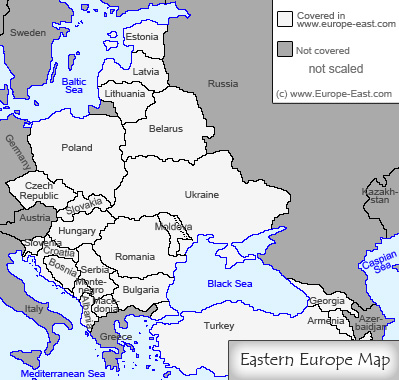 Eastern Europe is one of those regions that is easily forgotten. When we think of Europe, it is France, Italy, Spain, Germany, Portugal, Austria ..... that come to mind. But, as we head east of Austria, there is a whole new "old" Europe.
These are typically less affluent than Western European countries. (While I like the relative simplicity of the map here, we typically do not include Turkey in Eastern Europe. Perhaps Turkey is also like Afghanistan--has been at the crossroads in so many ways, and can be grouped with different regions, and does not quite fully belong to any!)
All these countries were under the influence of the Soviet Union. The two essays you have for the final week are about Romania and Georgia, on either side of the Black Sea. Very interesting essays, and will give you a feel for those countries. You will also see from those two essays that these two countries have a great deal of economic and social issues that are in common.
So, at this point in my "lecture" you are thinking, "just tell me what I have to do for the wrap-up task!" Well, if so, just hold your horses :-)
 Because, I want to spend a little bit of time about the way I have 'taught" this class this term. You may have noticed that I practically did not "lecture" at all, and was more a guide leading you up the path. Teaching has been with my "mouth shut". If you want more of an analogy, you can think of the role of a personal trainer in a gym--the user has access to all the equipment in the gym, and the trainer's role is to advise the user about what has to be done for the goal that the user has in mind. Ultimately, it is up to the gym user to do the reps. Well, a user like me have never had a trainer and dodges going to the gym; it shows :-)
One of the best things about the internet is that we now have access to all kinds of information--text, audio, video, historical and archival .... In the old, old days, students had to rely on the professor even for that information. Then textbooks made things different--students had access to knowledge in that book. In the contemporary context, and definitely for this course, my role is that of the guide rather than the "sage on the stage."
The reason I am taking up your time to discuss this wit you: once the term ends, I hope you will not stop understanding the world outside the US. Earlier generations at least had a valid reason--they did not have easy access to materials to further their understanding. We have no excuse at all. The regions we looked at need a whole lot of detailed understanding, because I am convinced that the future of the world will be shaped by developments there--which is also why I did not want us to spend time looking at the Americas, Western Europe, and Oceania. Not that these vast regions become irrelevant .... you get my point, I hope.
So, after all this, here is the final assignment--take time until next Wednesday (29th) if you need to:
- Read the two essays
- Identify an observation from each context
- Write about why those observations caught your attention, and explain whether you think those might be the same case with the rest of Eastern Europe as well
- All together in about 800 words
Tuesday, July 21, 2009
Afghanistan's place in the world

Through your work, you have identified how much of an interesting, and important, location Afghanistan has—now and in history. This is a country with a rich history, and a complex one too, and its modern story is even more complicated.
If we look at it from a physical geography perspective, the Indian Subcontinent is bordered by huge mountains all around. Well, this is no surprise given our understanding that this landmass is still on the move, pushing itself against the larger landmass, which is also why the Himalayas continues to grow at a little over two inches a year!
Afghanistan is on the other side of these mountains. From a crude sketch of the physical geography, we can then make an observation that this is a country that does belong more with Iran and the rest of Southwest Asia.


Going back some more in time, it was through the Khyber Pass that Central Asian warriors reached India, and then established the Mughal Dynasty. And even further back, before the advent of Islam, Buddhism played a major role even well into Afghanistan. As a couple of you pointed out, it was not any freakish accident that there were those giant Buddha statues in Afghanistan that later the Taliban blew up.
Retracing the historical path, we have ample evidence of a great deal of interaction between erstwhile kingdoms in Afghanistan and India.
It is, therefore, a tough call to make on whether Afghanistan is in Southwest Asia or in South Asia. It is not merely a matter of semantics—such a classification shapes our understanding of not only Afghanistan itself, but of those regions too.
As long as you have examined both the arguments, I don’t care whether you decided that Afghanistan is in South Asia, or Southwest Asia, or neither.

Any comments? Rejoinders?
Wednesday, July 15, 2009
More on Mapwork 2
Hey, for some reason there is a significant drop-off in the number of assignments I received. Very strange in the sense that I have never had such a decrease in the number in any of the online classes in the past.
I am now beginning to wonder whether my decision not to have discussion questions was a bad idea; whether that is a cause for a couple of students not to feel connected enough. I have always bugged students with discussion questions, and from a pedagogical perspective, I thought it was not delivering the kind of output I had imagined. Actually, it is not just me, and this is not merely in online classes--generating discussions have always been a challenge to most instructors, in the "real" and "virtual" worlds alike. In any case, if you have any thoughts on this, please let me know; student feedback has helped me a lot over the years in improving what I do. (Be thankful, therefore, that you were not in my classes when I started this career, if what I am today is an "improved" condition!!!)
I have posted my comments and the grade for your Mapwork 2. I noticed that most of you had not referenced the readings. So, I went back to the assignment details and noticed that the mandate to make appropriate references to the readings is not clear at all. I have mentioned it, but not emphasized it, which means that some of you might have interpreted the task different from how I had envisioned it. So, I need to own a part of that blame. Tell you what; when it comes down to calculating the course grades, I will make appropriate upward adjustments.
For the final mapwork, which is due next week, please make sure that you appropriately bring in arguments/quotes from the readings into the discussions.
Here are a few thoughts related to the Mapwork in addition to those I had posted earlier.
I am now beginning to wonder whether my decision not to have discussion questions was a bad idea; whether that is a cause for a couple of students not to feel connected enough. I have always bugged students with discussion questions, and from a pedagogical perspective, I thought it was not delivering the kind of output I had imagined. Actually, it is not just me, and this is not merely in online classes--generating discussions have always been a challenge to most instructors, in the "real" and "virtual" worlds alike. In any case, if you have any thoughts on this, please let me know; student feedback has helped me a lot over the years in improving what I do. (Be thankful, therefore, that you were not in my classes when I started this career, if what I am today is an "improved" condition!!!)
I have posted my comments and the grade for your Mapwork 2. I noticed that most of you had not referenced the readings. So, I went back to the assignment details and noticed that the mandate to make appropriate references to the readings is not clear at all. I have mentioned it, but not emphasized it, which means that some of you might have interpreted the task different from how I had envisioned it. So, I need to own a part of that blame. Tell you what; when it comes down to calculating the course grades, I will make appropriate upward adjustments.
For the final mapwork, which is due next week, please make sure that you appropriately bring in arguments/quotes from the readings into the discussions.
Here are a few thoughts related to the Mapwork in addition to those I had posted earlier.

Well, I have a beard. It used to be dark with streaks of grey, and then it became salt-and-peppery. Now, it is grey with some stray blackness :-) I suppose it is also worth mentioning that my beard has nothing to do with my religion, or lack of one.
That light-hearted comment aside, yes, religion plays a huge role in this region. To quote verbatim from a student:
I found it interesting as I read this week's readings how much Islam influences the cultural in these two regions and I thought at first that it was strange until I thought about how the U.S. and its cultural has been greatly influenced by the Christian faith throughout history. Once I realized that it seemed logical that the society and culture of North Africa and Southwest Asia should be shaped by Islam because it is the most common religion in the two regions and since religion is such a big part of many people's lives it makes sense for it to play a big role in society and culture.

You think these are hypothetical questions? Not at all; this is a “global issue”, and France, in particular, has been having a tough time with this. There are quite a few immigrants from North Africa--especially from Algeria--relating to the French colonial days. I thought this might be a neat example on how GEOG 410 builds on, and differs from, GEOG 310.
Water, as many of have noted, is a precious commodity in these regions. The Nile stands out, and we easily see the entire areas around the Nile as having much higher population densities compared to other places in North Africa.
Finally, pay attention to spelling. One paper had the student's first name mis-spelt. Another had "contras" when the student meant to convey "contrast." "Contras" is the correct spelling, yes, but not the word we want in that context. "Mubarak" was incorrectly spelt in more than one assignment. It might sound like I am nitpicking here. (BTW, ever wondered what "nitpicking" means? Click here for the original meaning, and here for what it has come to mean as a metaphor.) But, remember, your boss and the public will expect nothing but the best from you in your employment post-graduation. So, this is all a part of the training.
BTW, did you realize that we are now getting really close to the end?

If there is one reason I don't enjoy summer classes, it is this: just as I begin to understand the students in the class, the term ends and leaves me hanging .... Perhaps I will see a few of you in a course or two later on, and I will have opportunities to continue the conversations .... (Of course, I do have students in this class with whom I have interacted in at least one other course before.)
Friday, July 10, 2009
Sub-Saharan Africa: Ghana
 Last week we discussed Nigeria, the Sahel, and Sub-Saharan Africa.
It was timely; President Obama is in Ghana where, among other activities, he will also visit Cape Coast:
Why did he choose Ghana among all the countries there? It was the first ever country in Africa to become independent of European colonizers. More than that, Ghana has had a more stable society and politics than most Sub-Saharan countries.Built in the 1600s, Cape Coast Castle served as Britain's West Africa headquarters for the trans-Atlantic slave trade, which saw European powers and African chiefs export millions in shackles to Europe and the Americas.
The slave trade ended here in 1833, and visitors can now trek through the fort's dungeons, dark rooms once crammed with more than 1,000 men and women at a time who slept in their own excrement. The dank air inside still stings the eyes.
The NY Times:
Mr. Obama did not have too many options. From one end of the continent to the other, the sort of peaceful, transparent election that Ghana held last December is still an exception rather than the norm, analysts said. The same is true for the country’s comparatively well-managed economy.Two faculty in the Social Science Division are originally from Ghana. Vivian in CJ and Isidore in Anthropology. Maybe you know them. They will be delighted to chat with you about Ghana--tell them I sent you to them :-)“The choice was, in fact, quite limited,” said Philippe Hugon, an Africa expert at the Institut de Relations Internationales et Stratégiques in Paris. “It wasn’t huge.”
Countries like Botswana, Namibia and South Africa have consistently received better-than-average global scores for their governance in recent years, according to rankings based on World Bank research.
But a cartoon in this week’s Jeune Afrique, the French magazine widely followed on the continent, seemed to sum up Mr. Obama’s dilemma: John Atta-Mills, Ghana’s president, is depicted holding back the door of a hut labeled “West Africa” from which blood, a grenade and explosions with the names of various countries in the region are bursting.
The list of exploding countries, unstable countries, corrupt countries, is long. Military coups still break out with regularity, as in Guinea and Mauritania within the last year. Journalists in a number of countries continue to be killed, jailed, tortured, forced into exile or otherwise muzzled.
Subscribe to:
Posts (Atom)
