"One swallow doesn't make a summer" is the old saying. But, in a course like this, we simply do not have the luxury of time to read and discuss a lot and, therefore, we look at a swallow or two and .... move on to the next. But, I suppose I would like to remind everybody that what we have done thus far is a remarkably quick survey of a few regions of the world--regions that we might not have known much about prior to this class.
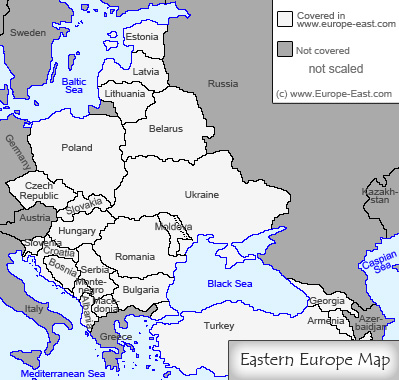 Eastern Europe is one of those regions that is easily forgotten. When we think of Europe, it is France, Italy, Spain, Germany, Portugal, Austria ..... that come to mind. But, as we head east of Austria, there is a whole new "old" Europe.
These are typically less affluent than Western European countries. (While I like the relative simplicity of the map here, we typically do not include Turkey in Eastern Europe. Perhaps Turkey is also like Afghanistan--has been at the crossroads in so many ways, and can be grouped with different regions, and does not quite fully belong to any!)
All these countries were under the influence of the Soviet Union. The two essays you have for the final week are about Romania and Georgia, on either side of the Black Sea. Very interesting essays, and will give you a feel for those countries. You will also see from those two essays that these two countries have a great deal of economic and social issues that are in common.
So, at this point in my "lecture" you are thinking, "just tell me what I have to do for the wrap-up task!" Well, if so, just hold your horses :-)
 Because, I want to spend a little bit of time about the way I have 'taught" this class this term. You may have noticed that I practically did not "lecture" at all, and was more a guide leading you up the path. Teaching has been with my "mouth shut". If you want more of an analogy, you can think of the role of a personal trainer in a gym--the user has access to all the equipment in the gym, and the trainer's role is to advise the user about what has to be done for the goal that the user has in mind. Ultimately, it is up to the gym user to do the reps. Well, a user like me have never had a trainer and dodges going to the gym; it shows :-)
One of the best things about the internet is that we now have access to all kinds of information--text, audio, video, historical and archival .... In the old, old days, students had to rely on the professor even for that information. Then textbooks made things different--students had access to knowledge in that book. In the contemporary context, and definitely for this course, my role is that of the guide rather than the "sage on the stage."
The reason I am taking up your time to discuss this wit you: once the term ends, I hope you will not stop understanding the world outside the US. Earlier generations at least had a valid reason--they did not have easy access to materials to further their understanding. We have no excuse at all. The regions we looked at need a whole lot of detailed understanding, because I am convinced that the future of the world will be shaped by developments there--which is also why I did not want us to spend time looking at the Americas, Western Europe, and Oceania. Not that these vast regions become irrelevant .... you get my point, I hope.
So, after all this, here is the final assignment--take time until next Wednesday (29th) if you need to:
- Read the two essays
- Identify an observation from each context
- Write about why those observations caught your attention, and explain whether you think those might be the same case with the rest of Eastern Europe as well
- All together in about 800 words


